· 7 min read
How to describe the site you want
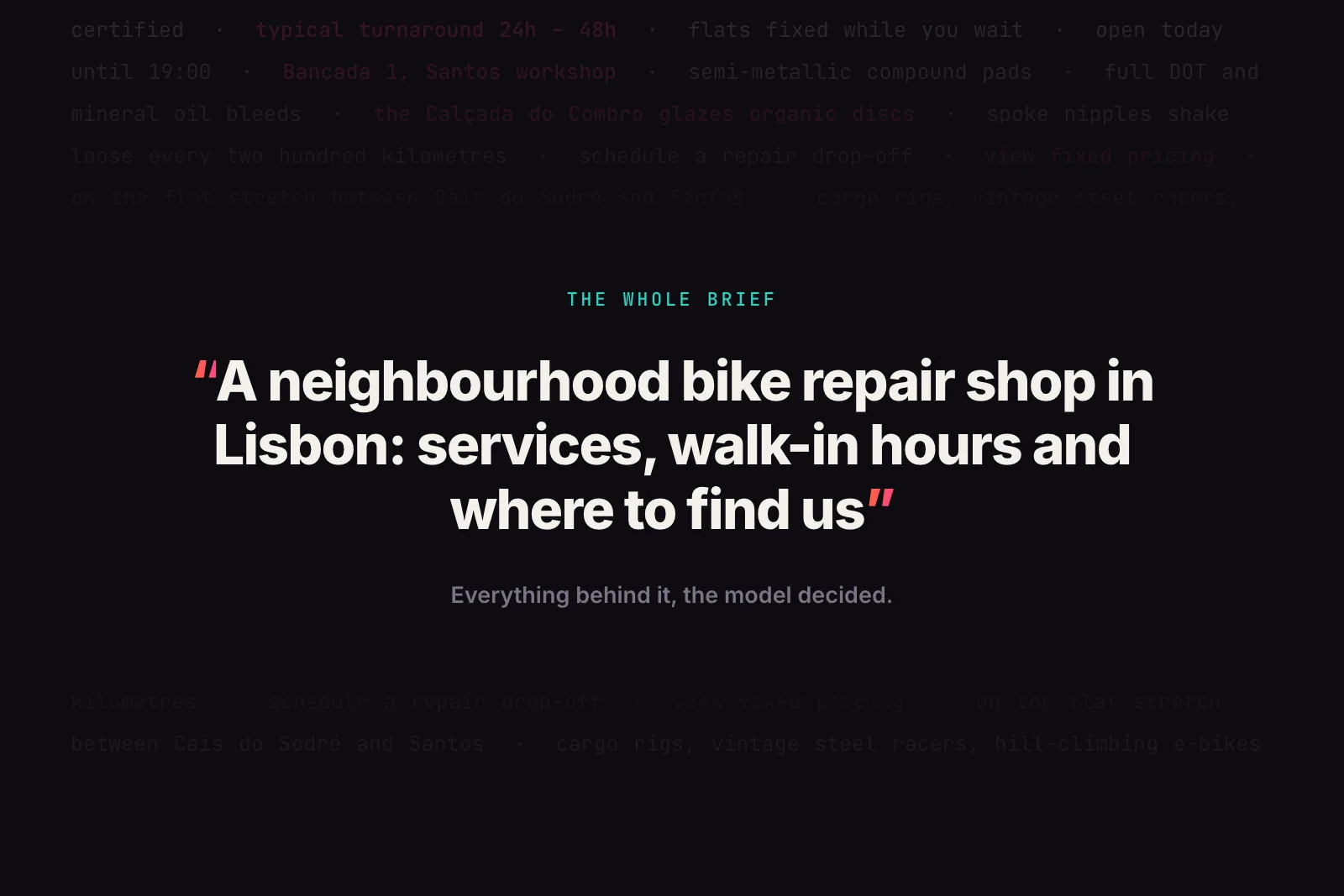
Here is a brief somebody typed into Dictumly. All of it:
A neighbourhood bike repair shop in Lisbon: services, walk-in hours and where to find us
Eighty-eight characters. What came back is a site for a shop on the flat stretch between Cais do Sodré and Santos, at Rua do Instituto Industrial 14, reachable on +351 213 974 411, certified for Shimano, SRAM, Campagnolo and Bosch, with a typical turnaround of 24 to 48 hours and a page explaining that dropping down the Calçada do Combro glazes organic disc pads, so they stock semi-metallic compound instead.
None of that was in the brief. Not the street, not the phone number, not one of the four brands, not the turnaround, not the hill.
The page is good. That is the problem, and it is the thing worth understanding before you write your own brief: the model does not leave gaps. It fills them, in detail, and convincingly. A thin brief does not produce a thin site. It produces a confident site about a business you did not describe.
What you name becomes the structure
Look at that brief again and count the nouns after the colon: services, walk-in hours, where to find us. Three things. The site came back with three items in its navigation — Services & Rates, Walk-in Hours, Where to Find Us — in that order.
This is the most reliable thing we know about briefing, and it is almost mechanical: a thing you name becomes a place on the page. Name three and you get three. Name none and the model picks, drawing on what pages for that trade usually have, which is a reasonable guess and not your business.
So the second half of a brief is a list, and it is the half people skip. Compare a fuller one, same trade, forty-seven characters longer:
A neighbourhood bicycle repair workshop in Ghent that also rebuilds vintage steel frames, with opening hours and a repair drop-off form
Two things were added and both arrived. The vintage-frame restoration is not a footnote on the resulting site, it is half of what the workshop is — because the brief said also rebuilds, which is a sentence about the business rather than a decoration. And the drop-off form exists because a form was asked for. The Lisbon site has a "Schedule repair drop-off" button too, which nobody requested; it goes with the furniture the model chose.
What you leave out becomes fiction
The Ghent site lists prices. From €45 for a commuter service, truing from €20, drivetrain overhaul from €65 plus parts. There were no prices in the brief either.
We could stop the model inventing and leave a blank where a fact belongs. We do not, deliberately: a page with holes in it is not a page you can look at and judge, and the whole point of a first pass is that you look at something real. But it puts a job on you, and it is the job nobody expects:
Everything you did not decide, the model decided — well enough that you will not notice you are reading it.
Nobody proofreads a page for facts that sound right. They proofread for typos, they approve the page, and six weeks later a customer rings the number that was never theirs. So the practical reason to write a fuller brief is not that the site comes out prettier. It is that every fact you supply is one you do not have to go and find afterwards.
A brief is a set of decisions, not a description
People arrive at the box thinking they have to describe their business, which is why the two failure modes are two words and a pasted About page. Neither is a brief. A brief answers three questions, and it can do it in one sentence each.
Who is it for
Not your market — the person who will have this page open. "Daily commuters and cargo bikes" and "collectors restoring 1980s racers" are the same trade and two different sites: different photographs, different order of sections, different first sentence. If you name nobody, the model writes for whoever the average visitor to that kind of page is, and averages have no address.
What must the page make happen
One thing, ideally. A booking, a phone call, a dropped-off bike, an email address. This is the question that decides the shape of the page rather than its contents, and it is the one most often left out. A site whose job is "get people to ring us" is not the same page as one whose job is "let people book without ringing us", even though both are a repair shop with a phone number on it.
What must appear
The list. Opening hours, four loaves with their flours, a price table, the team, a FAQ, a form. This is where you buy back the fiction. Here is the fullest brief on our shelf, at 279 characters:
A landing page for a neighbourhood sourdough bakery: a warm hero photograph of the bread, a short story about the overnight starter, four loaves with their flours and baking days, a picture of the counter in the morning, opening hours and a form to reserve a loaf for collection.
Six items, and every one of them is a thing rather than a sentence. No adjectives about quality, no mission, no tone of voice. It reads like an instruction to a photographer, and that is the right register.
Do not write the copy
The temptation, once you have understood that more is better, is to write the page. Don't — you will spend an hour producing something that gets rewritten anyway, and you will constrain the parts you should have left free.
The distinction that matters is between naming a shape and supplying prose. "Three sizes, the wood and the finish, and how to order one" is a shape: it says the page has three products, that material and finish are the axis a buyer chooses on, and that ordering is a step with its own place. Twelve words, and they determine a layout. The paragraph you would have written about your commitment to craftsmanship determines nothing, and the model writes a better one than you will, because writing that paragraph is the only part of this it does all day.
The facts only you have
One exception, and it is absolute. Anything the model cannot know and will therefore invent, give it verbatim:
- Names. The business, the people, the products. A shop called Redland Vets is not "your veterinary clinic".
- Numbers. Prices, phone, capacity, turnaround, how many seats are left.
- Where and when. The address and the opening hours, in the form you want them read.
- Anything with a date on it. A deadline the model guesses is a deadline that is wrong.
Everything on that list is a fact with exactly one correct value, and no amount of plausibility gets it right. Everything not on it — the wording, the order, the photographs, the section that explains what a bottom bracket is — is work you are paying us to do.
The test
Before you press the button, read your brief back and ask one question of it: if someone built this page from only these words, what would they have to make up?
Whatever the answer is, that is what you are going to get, written well and possibly wrong. Add the half of it you actually care about. Leave the rest — and the first thing you say once the site is live can be a correction, because by then there is something on the screen to correct.