· 7 min read
When you should not use a generated site
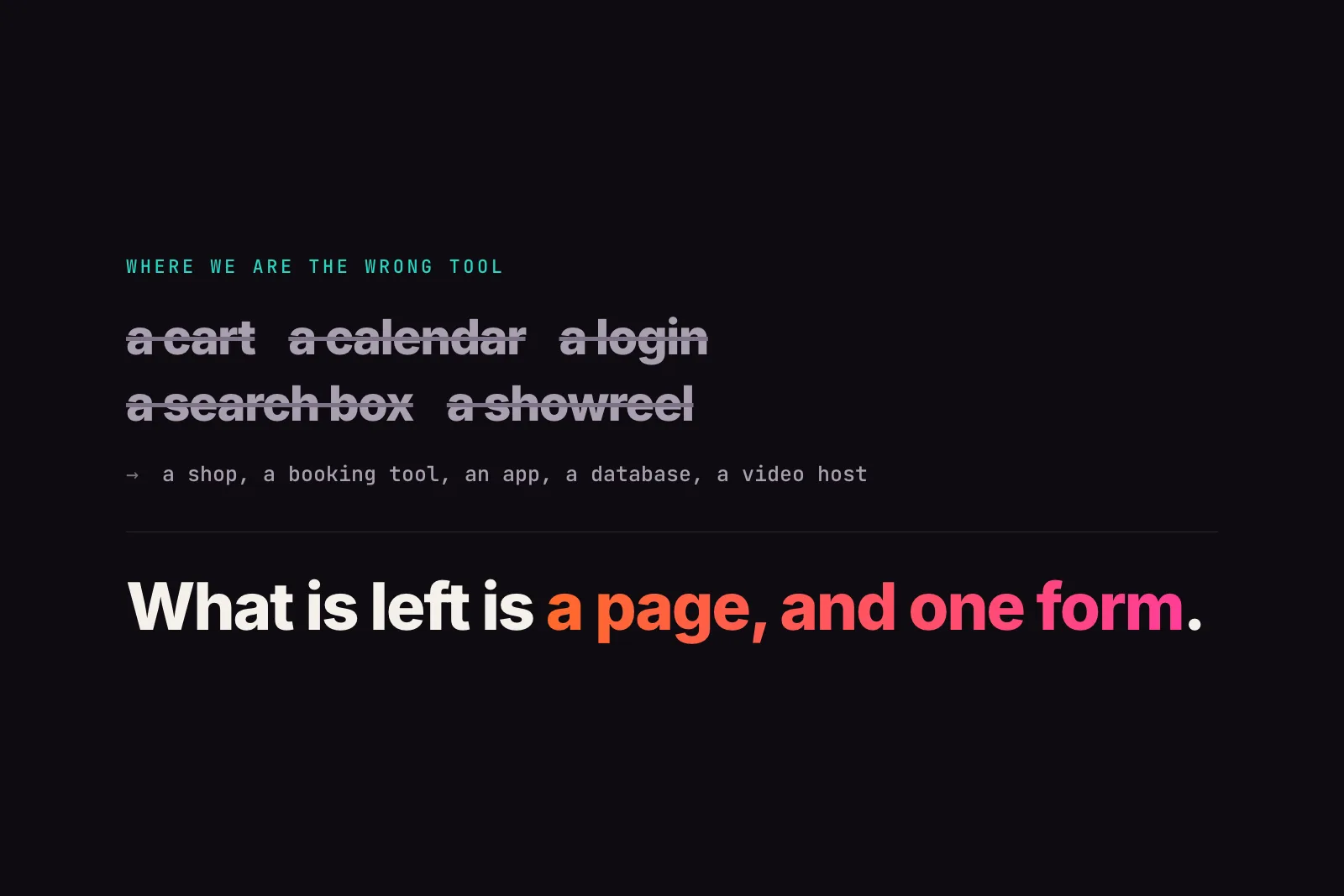
Here is the honest description of what you get from Dictumly: one page, sometimes a handful, written as markup, with exactly one moving part — a form. The words, the pictures and the layout are real; the site is served at its own address; the forms reach you. Nothing else on it moves.
That sentence is the whole of this article. Everything below is what follows from it, because a tool that never says what it is not is a tool you find out about on a deadline.
Five things it cannot do
Take money
There is no cart, no checkout, and nothing anywhere in the platform that talks to a payment provider on your site's behalf. A page can tell somebody the jacket costs $180; it cannot take the $180.
If you are selling more than a handful of things, put the shop on a shop: Shopify, WooCommerce, Ecwid, Gumroad — whatever suits the stock. If you sell two or three things, a payment link from your own payment provider, linked from the page, is usually the whole answer. In both cases a generated site is a good front door and a bad till.
Hold a slot
A form takes a request. It cannot know that Thursday at three is already gone, and it will happily take a second request for it. For a barber with six chairs or a consultancy with a calendar, that is not a small gap — it is the product.
Use a booking tool that owns the calendar and link to it from the page. The site's job is to say who you are, what it costs and why someone should book; the booking tool's job is to know what is free.
Know who is looking
Generated sites have no accounts. The machinery exists and is switched off on purpose: a sign-in that leads to nothing is worse than no sign-in, so the generator is forbidden to draw one. That rules out a member area, a client portal, a downloads page for paying customers, prices that change by who is logged in, and anything else that depends on the page recognising a person.
That is an application, and it wants to be built as one.
Search a catalogue
There is no database behind the page. Four loaves with their flours are markup; four thousand SKUs with filters are a system. The line is not the number of items — it is whether anyone has to find one. A list you can read top to bottom is fine at forty. Anything that needs a search box, facets or pagination is not.
Video
No video at all, and not as an oversight: the provider that generated clips for us stopped serving them, so the generator is instructed never to write a <video> element rather than leave a dead rectangle on a customer's site. If your case is a showreel, the work is the video, and you want a page built around an embed from a video host.
When the copy is the product
The model writes fluent, specific prose, and it does not stop at what you told it. Give it a thin brief and it invents an address, a phone number, a turnaround time and four brand certifications — we wrote a whole article about how to describe the site you want because of it.
On most pages that is a first draft you correct. On some pages it is a liability:
- Regulated claims — medical, financial, legal. A plausible sentence about what a treatment does, or what a return will be, is the kind of sentence a regulator reads back to you.
- Safety or instruction — dosages, procedures, anything somebody follows. Wrong and confident is the worst possible combination.
- Work whose voice IS the offer — a manifesto, a novelist's page, a piece of writing people are buying because of how it is written. Generated prose has a register, and it is not yours.
In all three, write the words yourself. That is a perfectly good way to use this: paste your copy, ask for a page around it, and let the machine do the layout, the type and the photographs. It is the invention that is dangerous, not the tool.
What we do not claim
Our own security page is the shortest way to see the edges. It lists what the code enforces, and it says plainly what we do not have: no SOC 2, no ISO 27001, no "your data never trains a model", no data-residency promise. It also has a section most pages leave out — what leaves the platform — because your brief and your site's text go to a third-party model provider to be written.
The legal pages still carry a Draft banner and two unanswered placeholders, which are counsel's calls and not ours to invent.
So: if a buyer's security review asks for certifications, a data-processing agreement with named sub-processors on your terms, residency in a particular country, or SSO for your team, today's answer is no. That is not a roadmap hint. It is where we are.
The limits, with their numbers
These are not judgement calls, they are enforced in code, and generation refuses rather than half-delivers:
- Pages per site: three on the trial, eight on Pro, twenty on Business. A forty-page brochure site is the wrong shape here whatever the plan.
- Pictures per site: twenty-four, and twenty megabytes after they are re-encoded. Past that the pictures stop arriving.
- Six kinds of page on offer: a landing, a live backdrop, a product page, a portfolio, a waitlist and a promo page. Blog and the scroll-film hero exist in the code and are withheld, because we do not offer what we cannot currently deliver well.
And the cost of constant change
An edit is not a patch. The model is handed your whole site to read before it changes a line, so changing something costs roughly what writing it cost — on this installation a text run's median is 2.8 credits, with most between 1.8 and 4.9.
For a site that settles down after a week of edits, that is nothing. For a page somebody rewrites every Tuesday — a menu that changes daily, a news feed, a listings page — you are paying a model to re-read the whole site each time, and a content management system is both cheaper and faster. Build the shell here; keep the churn somewhere it is free.
The grey area, and how to tell which side you are on
Three questions. Any yes and you are looking at an application:
- Does the page have to remember anything between visits? A cart, a login, a saved preference, a history.
- Does it have to decide anything? What is in stock, what is free on Thursday, what this customer's price is, whether someone qualifies.
- Does it have to take money?
Three noes and you are on our side of the line, and most small businesses are: a bakery, a bindery, a physio, a photographer, a studio, an event, a product waiting for its first hundred email addresses.
If you are on the wrong side, we are still the front door
Almost nobody needs only the application. The shop still needs a page that says who makes the jackets; the booking tool still needs a page that says why to book. That page is exactly what this builds, and it takes about a minute.
And starting here does not trap you. A custom domain you have connected is yours, and pointing it at something else later is a DNS change, not a migration. The page you replace it with will be better for having had a year of a real one to learn from. A tool that tells you when to stop using it is an easier tool to start using.