· 7 min read
What a bakery website actually needs
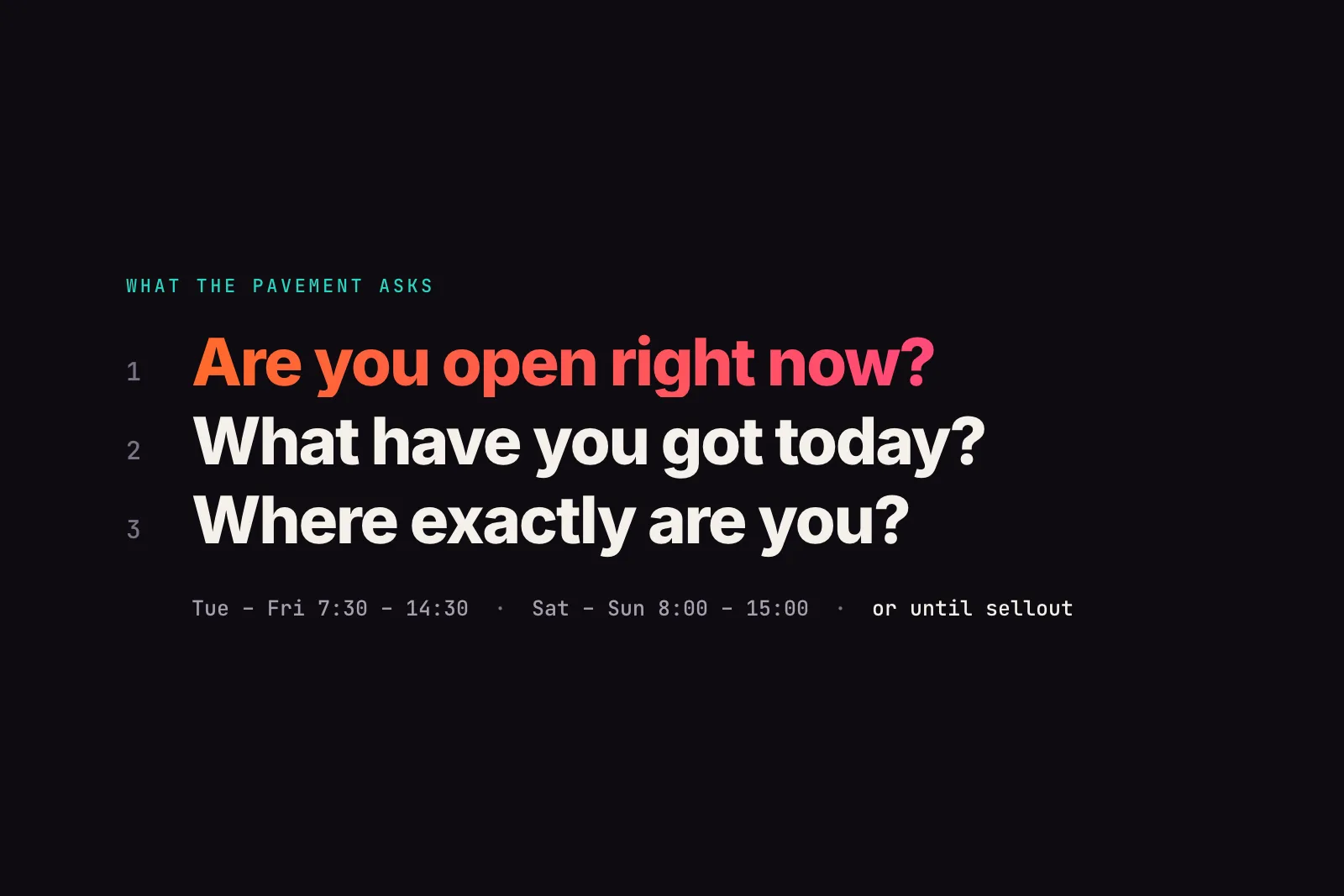
Picture the person your bakery website is actually for. Not a food writer, not a supplier. Somebody on the pavement two streets away, at twenty past eight, with a phone in one hand and a coat half on. They are asking three questions, and they will give the page about as long as it takes a bus to pull in.
- Are you open right now?
- What have you got today?
- Where exactly are you?
Everything else on the site — the story of the starter, the photographs of the oven, the paragraph about the farm the rye comes from — is for the second visit. It is worth having. It is not what gets someone through the door this morning, and a bakery site that makes them scroll past it to find the hours is spending its best reader on its least urgent page.
The first screen decides
We looked at two bakery sites on our template shelf on a phone-sized screen, 375 pixels across. Both are good sites. Both open the same way: a headline about slow fermentation, a paragraph about the starter, two buttons.
On The Daily Crumb, the opening hours start a little over six screens down the page. On Ember & Levain they are further still — past the bread list, past the story of the levain, about eight screens in.
That sounds damning, and for one of them it isn't. Ember & Levain's second button, right there on the first screen, says Village Hours & Saturday Market, and it jumps straight to them. One tap. The answer lives low on the page; the way to it lives at the top. The Daily Crumb has a perfectly good "Hours & Location" link too — in its navigation bar, which on a phone is hidden altogether. The first screen offers a reservation and a tour of the loaves instead.
So the rule is not "put the hours at the top", which would push the bread off the first screen and make the page look like a timetable. It is: the first screen must answer the three questions or point at the answers. A button that says Hours & where to find us does the job. A hamburger menu does not, because nobody on a pavement opens a menu to see whether you exist.
Hours are text
Both of these sites set their hours as plain text, which is right, and it is worth saying why, because the most common alternative is a nicely designed image of a chalkboard.
An image of your hours cannot be read aloud by a screen reader. It cannot be translated by the browser of a visitor who doesn't read your language. It cannot be copied into a message to the friend you are meeting. It will not be found by someone who searched for your name and "Sunday". And the day you close early for a holiday, it has to be redrawn — so it isn't, and the chalkboard goes on saying you're open.
Write them the way someone would read them out:
Tuesday – Friday, 7:30 – 2:30
Saturday – Sunday, 8:00 – 3:00
Monday: closed
And say the thing that is true of every bakery and almost no other shop: the hours are really "until it's gone". Ember & Levain writes 7:30 AM – 1:00 PM (or until sellout), and underneath, that loaves often sell out by half past eleven in trekking season. That one line is more useful than the hours themselves. It tells a visitor that 12:45 is technically open and practically pointless, and it sells the reservation form without a word of selling.
The PDF menu
If there is one thing to take off a bakery website today, it is the link that says Download our menu (PDF).
On a phone, a PDF is a detour. It opens in another viewer, or downloads to a folder the visitor will never look in, and it arrives at a width designed for A4 — so they pinch, and scroll sideways, and lose their place. It is invisible to search: the fact that you bake a rye with caraway on Thursdays exists only inside a file nobody's search engine opens. And, like the chalkboard image, it goes stale, because changing it means finding the original document, editing it, exporting it and uploading it again. The PDF on most bakery sites describes the bakery as it was the week the site was made.
The bread list belongs on the page, as words. The Daily Crumb lists four loaves, and against each one, the days it is baked: Country Hearth Boule, Tue – Sun. Dark Rye & Sprouted Seeds, Thu & Sat. That is the answer to the second question, and it is the part of a bakery that no other kind of shop has. A clothes shop's stock is the same on Thursday as on Wednesday. Yours isn't, and saying which day is which is the most useful sentence on the page.
One photograph
The last habit worth breaking is the carousel — the big image at the top that slides to another image every few seconds.
Almost nobody sees past the first slide; the others cost the page their weight and give nothing back. The slides move while people are trying to read the words laid over them. And a carousel is usually a sign that nobody chose: it holds five photographs because deciding which one was the bakery felt too hard.
Choose. The photograph that sells a bakery is the bread, close enough to see the crust. The Daily Crumb opens on exactly that — a cracked, flour-dusted boule on a wooden peel — and holds the counter shot back until the section that talks about the counter. Neither of our two sites has a carousel, and neither looks the poorer for it. The oven, the hands, the market stall: put them further down, next to the words they illustrate, where each one is doing a job instead of waiting its turn.
What to tell us
If you are building one of these with Dictumly, the brief almost writes itself from the three questions. There is one thing to watch. Both of these sites came back with a street address that neither brief gave, and Ember & Levain with a price on every loaf — its brief asked for prices and never said what they were. The model supplies plausible ones, and plausible is not yours. We wrote about why that happens in how to describe the site you want.
So give it the facts only you have, exactly:
- Your opening hours, day by day, and what time you usually sell out.
- The loaves, and which days each one is baked.
- The address as you would say it to someone new — "the alley behind the church" included, if that's how people find you.
- Whether people can reserve, and until what time a reserved loaf is held.
Then leave the story of the starter to us.
The test
When the site is up, go and stand outside a shop that isn't yours. Open your own page on your phone. Count how long it takes you to find out whether you're open, what's on today, and how to get there.
If it is longer than a bus takes to pull in, the page is about your bakery. It needs to be for the person outside.